Outsourcing vs. Contracting vs. Full-Time Hiring

Choosing the Right Workforce Strategy

In today’s fast-changing business environment, organizations have more options than ever when it comes to getting work done. Beyond traditional full-time hiring, companies can now rely on contractors or outsource entire functions to specialized providers.
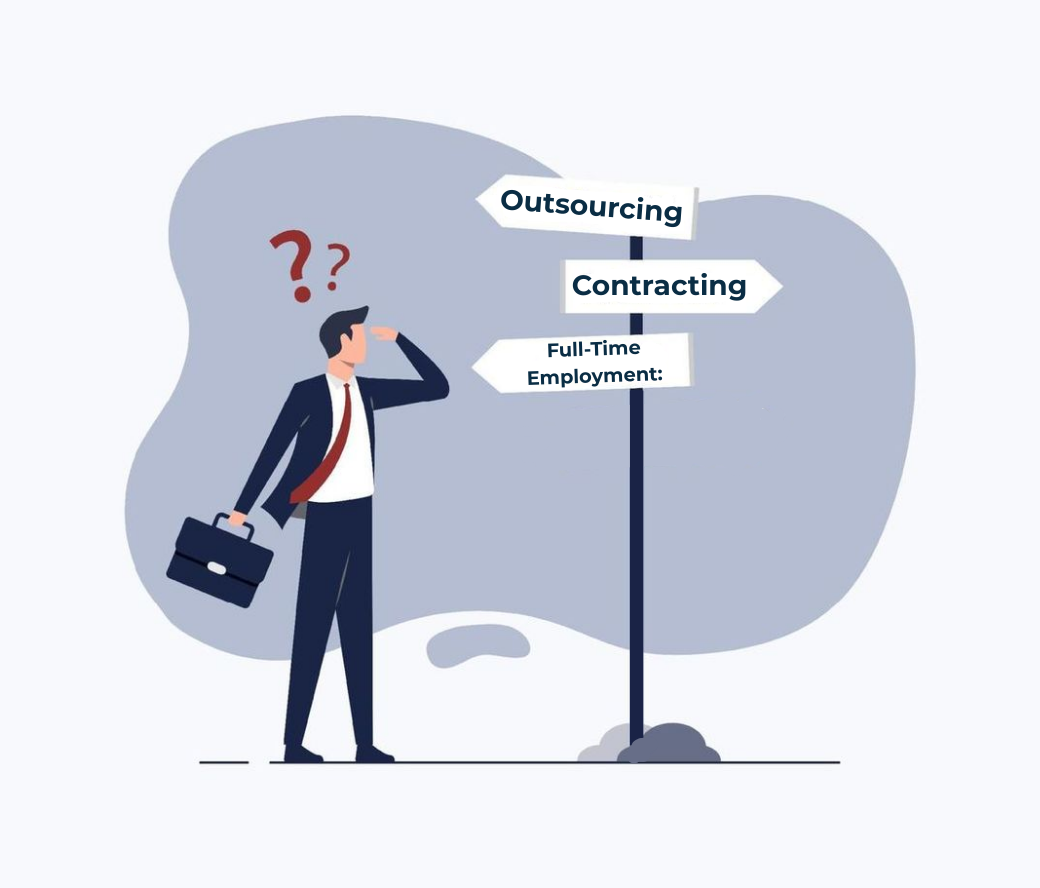
But which approach is best?

Outsourcing, contracting, and full-time hiring each have distinct advantages and limitations. Understanding the differences is essential for leaders who want to control costs, manage risk, and scale effectively.

What Is Full-Time Hiring?
Full-time hiring is the conventional model: recruiting employees who work directly for your company on a permanent basis.
Key Characteristics
  • Long-term employment relationship
  • Fixed salary and benefits
  • Direct management and oversight
  • Integration into company culture
Pros of Full-Time Hiring
  • Strong loyalty and commitment
  • Deep organizational knowledge
  • Greater control over work processes
  • Easier collaboration and alignment
Cons of Full-Time Hiring
  • Highest overall cost
  • Recruiting takes time
  • Limited flexibility
  • Legal and HR obligations
Full-time hiring makes the most sense for core roles—positions tied directly to strategy, leadership, intellectual property, or long-term growth.
What Is Contracting?
Contracting involves engaging an independent professional or freelancer to perform specific tasks or projects.
Key Characteristics
  • Usually project-based
  • Paid per hour or deliverable
  • Not entitled to employee benefits
  • Short-term or part-time arrangement
Pros of Full-Time Hiring
  • More affordable than full-time staff
  • Access to specialized skills
  • Flexible engagement terms
  • Faster onboarding
Cons of Full-Time Hiring
  • Limited availability
  • Less commitment
  • Knowledge leaves when the project ends
  • Requires direct supervision
Contractors are ideal when you need expertise for a defined initiative such as website development, accounting cleanup, or marketing campaigns.

However, contractors typically function as individuals—not as systems. You still need to manage them.
What Is Outsourcing?
Outsourcing is fundamentally different. Instead of hiring a person, you engage a company to take responsibility for a business function.

This may include customer support, IT services, bookkeeping, property management operations, or recruitment processing.
Key Characteristics
  • Service-level agreements (SLAs)
  • Managed by the outsourcing provider
  • Process-driven delivery
  • Scalable teams
  • Ongoing operational responsibility
Pros of Outsourcing
  • Lowest operating cost
  • Immediate scalability
  • No HR burden
  • Built-in expertise and infrastructure
  • Business continuity
Cons of Full-Time Hiring
  • Less direct control
  • Requires clear communication
  • Dependent on vendor quality
  • Not suitable for all roles
Outsourcing works best for non-core but essential activities. It allows internal teams to focus on high-value priorities while a partner handles execution.
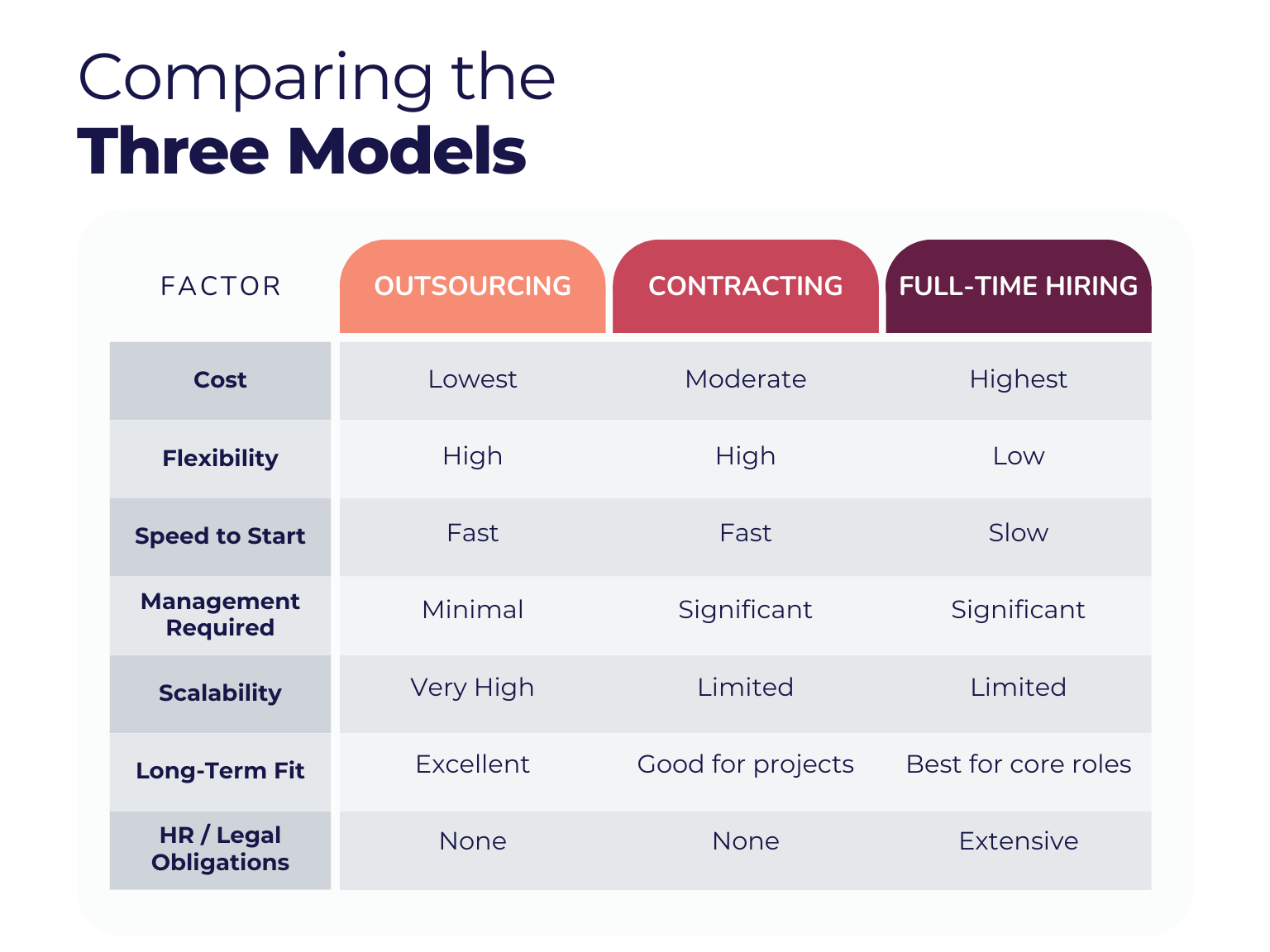
Comparative Summary
When to Use Each Approach
Choose Full-Time Hiring When:
  • The role is central to your competitive advantage
  • You need in-house leadership
  • Institutional knowledge is critical
  • The workload is permanent and predictable
Choose Contracting When:
  • You need a specialist temporarily
  • Work is clearly defined
  • You have capacity to manage the contractor
  • The project has an end date
Choose Outsourcing When:
  • You want to reduce operational cost
  • Tasks are repetitive or process-based
  • You need to scale quickly
  • Work is important but not strategic
  • You prefer outcomes over headcount
A Hybrid Strategy Is Often the Best Answer
Modern companies rarely rely on just one model.

High-performing organizations combine:
  • Full-time leaders and strategists
  • Contractors for niche expertise
  • Outsourcing partners for back-office and operational execution
This blended workforce approach delivers the best balance of agility, efficiency, and control.
Final Thoughts
There is no universal “best” hiring model—only the best model for a particular need.

The key question for decision-makers is not:

“Should we outsource or hire?”

But rather:

“What is the smartest way to get this specific work done?”

By aligning the right workforce strategy to the right function, businesses can grow faster, operate leaner, and compete stronger in the years ahead.
Need help deciding?
Workforce strategy is easier when you have the right partner guiding you.
© 2024 AUXGP. All right reserved.